
Trial Week Fitness Classes That Build Discipline
November 7, 2026
Strength Training Builds a Calmer, Stronger You
November 11, 2026
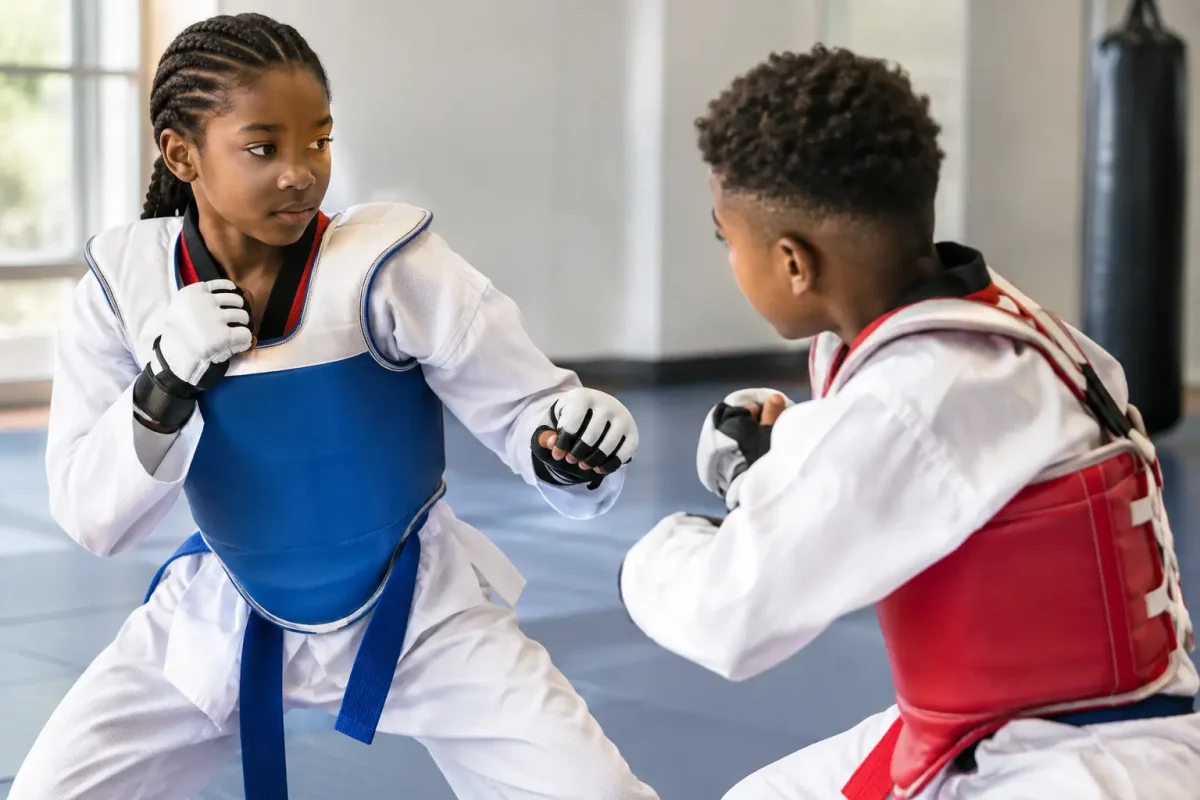
A child throws a careful punch, their partner steps back, and both pause for instruction. No one is trying to win a playground fight. They’re learning distance, restraint and recovery under pressure. So, can children spar? Yes, when sparring is earned, closely supervised and designed around development rather than adult competition.
For many parents, the word “sparring” raises immediate concerns. That instinct is sensible. Uncontrolled contact, mismatched partners and coaches who treat children like miniature adults have no place in a serious martial arts programme. But removing every challenge isn’t the answer either. Properly coached sparring can teach a child how to stay calm, follow rules and make decisions when their heart rate rises.
The goal isn’t to create aggression. It’s to build control.
Can Children Spar Safely?
Children can spar safely when the academy has clear standards for readiness, supervision, contact and culture. Age matters, but readiness matters just as much. A focused eight-year-old who listens, respects boundaries and can perform basic movements with control may be better prepared than an older child who can’t yet regulate frustration.
Sparring should never be the first thing a new student does. Before contact begins, children need time to learn stance, balance, safe falling where relevant, defensive movement, distancing and how to stop immediately when instructed. They must understand that their training partner isn’t an opponent to hurt. They’re a teammate helping them improve.
At the earliest stages, sparring may not look like sparring at all. It can be a movement game, a light touch drill or a supervised exercise where one child practises avoiding while another practises controlled targeting. The intensity rises only when skill, judgement and emotional maturity rise with it.
This is why a quality coach doesn’t simply ask, “How old is your child?” They also ask: Can they listen when excited? Can they handle losing a round without melting down or lashing out? Can they use appropriate force? Can they say when they feel uncomfortable? These are safety skills, not extras.
Sparring Is a Lesson in Nervous System Control
Children don’t build confidence by hearing that they’re confident. They build it by meeting manageable discomfort, using a skill, and discovering that they can recover.
Sparring creates a controlled version of pressure. A child has to notice movement, make choices and regulate their body in real time. They may feel nervous before the first round. Their breathing may become shallow. They may freeze, rush forward or avoid eye contact. These responses are normal. Good coaching gives them a structure for working through them.
They learn to breathe, reset their stance, look up and try again. Over time, that pattern becomes useful beyond the training floor. The child who can pause after being tagged, hear feedback and re-engage is practising a powerful life skill: emotional recovery.
This has particular value for children with anxiety, ADHD or autism, although no two children need the same approach. Some may thrive with short, predictable rounds and a familiar partner. Others may need extra time watching before participating. A neurodiversity-friendly programme doesn’t lower the standard of discipline. It makes the route to that standard clearer, safer and more individual.
What Safe, Age-Appropriate Sparring Looks Like
The quality of sparring is determined long before the bell, timer or first exchange. It’s built into the room’s rules, coaching ratios and everyday culture.
A responsible children’s programme uses size- and skill-appropriate pairings. A large, experienced child shouldn’t be asked to overwhelm a smaller beginner simply because they’re close in age. Coaches should actively monitor pairings and change them quickly if the energy becomes too intense, fearful or careless.
Contact must also fit the discipline and the child’s stage. In striking arts, early sparring should prioritise touch, accuracy and defence over power. Protective equipment can reduce risk, but it doesn’t make poor judgement safe. Headgear, gloves, shin guards and mouthguards are tools, not permission to hit harder. The coach still sets the pace.
In grappling-based training, safety means teaching children how to tap, release immediately and avoid dangerous techniques or positions. There should be no tolerance for roughness disguised as competitiveness. A child who refuses to let go, ignores a tap or laughs at another child’s discomfort needs correction straight away.
Clear stop signals matter. Every child should know that they can pause when they feel unwell, frightened or overwhelmed. They should never be shamed for doing so. Courage isn’t silence. Courage is communicating clearly, regaining control and returning when ready.
The Difference Between Sparring and Fighting
Parents often worry that martial arts will make their child more likely to fight. The opposite can be true when training is taught properly.
Fighting is unstructured, emotional and aimed at domination. Sparring is consensual, rule-bound and supervised. Fighting rewards impulsiveness. Sparring exposes impulsiveness and teaches a better response. A child who repeatedly charges in, swings wildly or becomes upset when touched isn’t praised for being “tough”. They’re coached to slow down, protect themselves and respect the agreement.
That distinction must be explicit. Children should hear it often: martial arts skills are for training, self-protection and disciplined sport, not for showing off, bullying or settling arguments at school. The strongest student in the room isn’t the one who hits hardest. It’s the one who can control their actions when they’ve the ability to do harm.
Parents can reinforce this message at home. Ask not only whether your child won, but what they learned. Did they keep their hands up? Did they listen? Did they help a partner? Did they manage nerves better than last week? Those questions teach children what progress actually means.
When a Child Isn’t Ready to Spar
Not every child should spar immediately, and not every child will enjoy it in the same way. That isn’t failure. Readiness can change with age, confidence, previous experiences and what else is happening in a child’s life.
A child may need more foundation work if they consistently ignore instructions, use too much force, become distressed by normal corrections or can’t separate training from anger. They may also need a pause from sparring after illness, injury or a difficult emotional period. The right response isn’t to label them weak or naughty. It’s to strengthen the missing skill before placing them back under pressure.
Parents should be cautious of programmes where every child is pushed into hard contact to prove themselves. Pressure without preparation doesn’t build resilience. It builds fear, avoidance or unsafe habits. Equally, an academy that never allows a child to test their skills may leave them unprepared for the emotional challenge that martial arts can teach so well.
The middle path is progressive exposure. First learn the movement. Then practise it with a cooperative partner. Then add choice, timing and light resistance. Each stage should be demanding enough to create growth, but controlled enough that the child can succeed through attention and effort.
Questions Parents Should Ask Before Enrolling
Before choosing a martial arts programme, watch a children’s class if possible. Look beyond the techniques. Notice how coaches speak when a child is frightened, distracted or overly competitive. Notice whether corrections are calm and specific, and whether confident children are taught to look after less experienced partners.
Ask how children are matched for sparring, what level of contact is allowed, which protective equipment is required and how coaches manage a child who becomes overwhelmed. Ask whether sparring is compulsory and how beginners progress towards it. Direct answers are a good sign. Vague reassurance isn’t.
At Edson Breedy Athletics, the standard is disciplined progress with care. Children need challenge, but they also need a structure that respects their bodies, their developing minds and their individual starting point.
A well-run sparring class gives a child something more valuable than a medal or a hard punch. It gives them repeated proof that pressure can be handled: breathe, think, control yourself, and take the next step.
Train your mind. Build your body.
Your first week is just TTD $50, every discipline, every class, no experience needed. Come find out what training with EBA feels like.