Exercise for Anxiety Relief That Builds Control
July 15, 2026
Autism Friendly Martial Arts Build Confidence
July 17, 2026

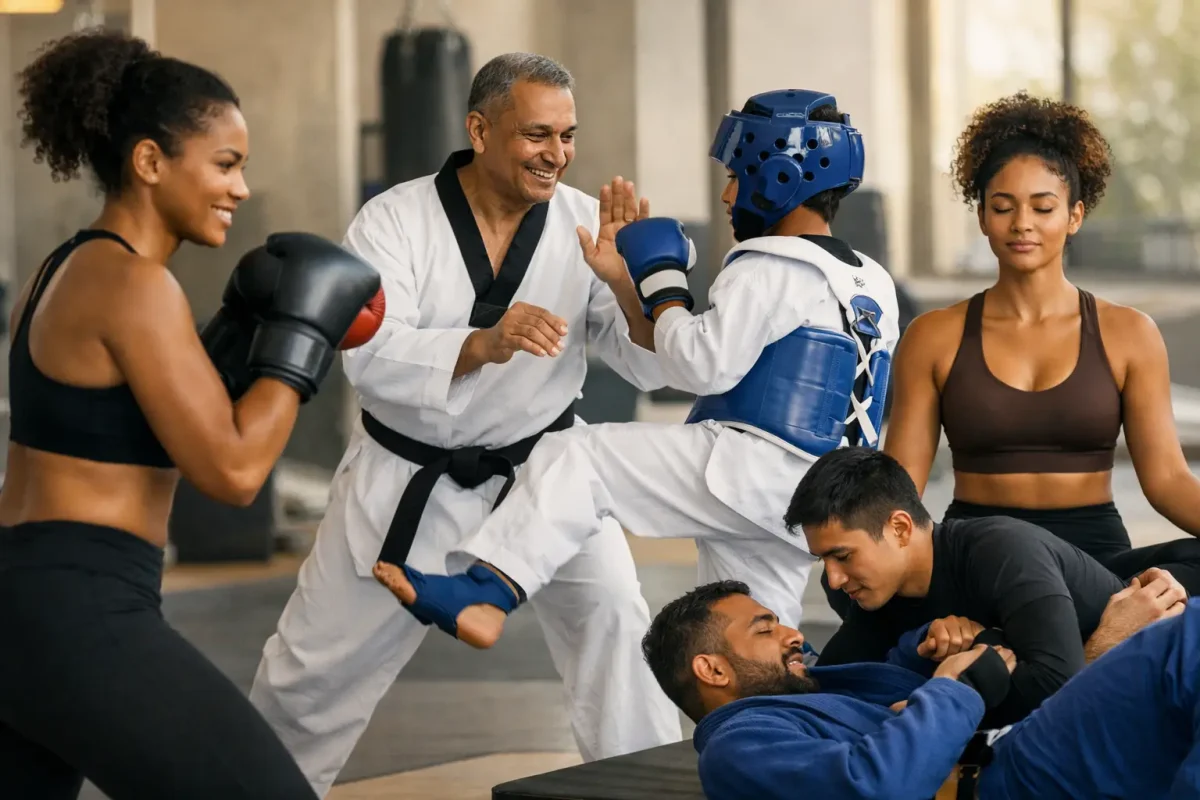
A child who can’t sit through homework may stay fully engaged through a demanding Taekwondo sequence. An adult whose mind races after work may leave a boxing session feeling quieter, clearer and more in control. That’s the value of fitness classes for ADHD when they’re designed with structure, not just sweat, in mind.
ADHD isn’t a lack of potential or a character flaw. It’s a different pattern of attention, impulse control, motivation and nervous system regulation. The right training environment gives that energy somewhere useful to go. It creates a repeatable practice of showing up, listening, moving, recovering and progressing.
This isn’t about forcing someone to become still. It’s about teaching them how to direct themselves.
Why movement can help an ADHD brain
Many people with ADHD feel better after exercise, but the reason matters. Physical activity can support mood, attention and stress regulation by giving the brain meaningful sensory input and using up restless physical energy. Intense movement may also create a clearer transition from agitation to calm.
That doesn’t mean every workout will improve focus immediately, or that exercise replaces medical care, therapy, school support or prescribed treatment. ADHD is individual. Sleep, medication, anxiety, sensory sensitivities, trauma history and daily stress can all affect what a person needs from training.
Still, consistent exercise can become an important part of a wider support system. The key word is consistent. A random hard session may feel good. A structured weekly practice builds a pattern: effort, recovery, feedback and return.
For children and teenagers, that pattern can support emotional regulation and confidence outside the training floor. For adults, it can become a reliable boundary around stress, scattered energy and the temptation to negotiate with yourself after a difficult day.
What makes fitness classes for ADHD effective?
Not every class suits every ADHD brain. A crowded, unstructured workout with vague instructions can leave someone more overwhelmed than when they arrived. The best fitness classes for ADHD tend to combine clear expectations with enough variety to keep attention active.
Structure removes unnecessary decisions
People with ADHD often spend a great deal of energy managing transitions and choices. A well-run class reduces that burden. There’s a clear start time, a warm-up, a defined skill to practise, coached drills, a finish and a next step.
This doesn’t make training rigid in a negative sense. It makes it predictable. Predictability gives the nervous system information: you know what’s expected, where to stand and what comes next. That can make it easier to engage.
Martial arts are particularly strong here because progression is visible. A new stance, combination, escape, form or belt level gives effort a target. You aren’t simply trying to “burn calories”. You’re building competence.
Short feedback loops hold attention
Long explanations and distant goals can lose people quickly. Good coaching uses brief demonstrations, simple cues and immediate practice. The trainee tries the movement, receives a correction and tries again.
That feedback loop matters. It turns attention into action. It also gives members a constructive experience of correction: not shame, not criticism, but information that helps them improve.
For a child who often hears what they did wrong at school, this can be powerful. For an adult who has spent years questioning their consistency, it can rebuild trust in their own ability to learn.
Intensity needs a purpose
High-energy training can be excellent for ADHD, but more intensity isn’t always better. Boxing, kickboxing and conditioning can provide a strong outlet for stress and excess activation. Yet a class should also teach breathing, technique, pacing and recovery.
The goal isn’t to leave every session exhausted. The goal is to become more capable of regulating your state. Some days that means pads and powerful combinations. Other days, yoga, mobility work or technical jiu-jitsu may be the better choice.
Discipline isn’t punishment. It’s the ability to choose the right demand for the day and complete it with intent.
Which types of classes may suit different needs?
The best starting point depends on age, interests, sensory preferences and goals. A person who dislikes contact may not enjoy sparring-based training, while someone who needs a strong physical outlet may find gentle movement alone unsatisfying.
Taekwondo can suit children and teens who benefit from routine, clear rituals and measurable progression. Forms, drills and belt systems reward attention to detail while giving energy a disciplined channel. It’s also a strong confidence-builder for young people learning boundaries and self-control.
Boxing and kickboxing can work well for teens and adults who want stress relief, fitness and immediate engagement. Punching combinations demand coordination, timing and presence. A good coach keeps the environment controlled, technical and safe rather than chaotic or aggressive.
Jiu-jitsu may appeal to people who enjoy problem-solving. It requires patience and body awareness, but it also offers constant decision-making and close feedback. Because it involves proximity and contact, beginners should be given a gradual, respectful introduction, especially where sensory sensitivity or anxiety is present.
Yoga and mobility-based training can help members practise breath control, balance and recovery. For some people with ADHD, a slow class feels challenging at first because there’s less external stimulation. That doesn’t mean it’s a poor fit. It may be a useful complement to higher-intensity sessions, provided the coaching is clear and the environment feels welcoming.
General fitness works best when it’s coached rather than left entirely to self-direction. Stations, timed intervals and attainable personal targets can make exercise more engaging. The trade-off is that variety must not become confusion. A trainee should understand the purpose of every drill.
How parents can choose the right class
Parents don’t need a programme that promises to “fix” ADHD. They need an environment that respects their child, sets standards and teaches skills that transfer beyond the class.
Watch how instructors communicate. Are instructions brief and specific? Do they redirect behaviour calmly? Is there a clear routine? Are children praised only for winning, or also for effort, listening, courage and self-control?
Also consider class size, age grouping and transition points. A younger child may need more movement and simpler cues. A teenager may respond better to being treated with responsibility and given a meaningful challenge. If a child is new to group activities, a trial period is useful because fit can’t be judged from a timetable alone.
Most importantly, don’t chase the class that looks easiest. Choose one that’s supportive and appropriately demanding. Children grow when adults hold the line with care.
How adults with ADHD can stay consistent
Motivation is unreliable. That’s true for everyone, but it can be especially relevant for adults with ADHD, whose interest and energy may fluctuate sharply. Stop waiting to feel perfectly ready. Build a system that makes attendance the default.
Choose regular class times that require the fewest decisions. Pack your kit before work. Tell one person where you’re going. Treat training as an appointment, not a reward you’ve to earn after completing everything else.
It also helps to pick a discipline you genuinely enjoy. If you’re bored by treadmills, don’t build your whole plan around a treadmill. Skill-based training gives the brain something to pursue beyond the scale or the mirror. You can improve a combination, refine your footwork, earn a grade or become steadier under pressure.
There will be inconsistent weeks. Illness, workload, family obligations and low mood happen. The answer isn’t all-or-nothing thinking. Return to the next class. One missed session is life. Quitting because of one missed session is a decision.
The coaching standard matters
Neurodiversity-friendly training isn’t about lowering standards or treating members as fragile. It’s about delivering standards in a way people can understand and practise. Clear instructions, consistent boundaries, options for progression and respectful corrections create a safer learning environment for everyone.
At Edson Breedy Athletics, that approach is grounded in doctor-designed coaching and a belief that physical training should strengthen the mind as well as the body. Beginners, children, committed athletes and members managing ADHD all need the same foundation: a place where effort has direction.
Look for coaches who can challenge a trainee without humiliating them, adapt a drill without making it feel like exclusion, and recognise when more pressure is helpful versus when a calmer reset is needed. That balance is experience, not gimmick.
Your energy isn’t the enemy. Your mind doesn’t need to be shamed into focus. Put that energy into a structured class, practise the skills repeatedly, and let discipline become something you can feel in your body long before you can explain it in words.
Train your mind. Build your body.
Your first week is just TTD $50, every discipline, every class, no experience needed. Come find out what training with EBA feels like.