Why Family Martial Arts Classes Build Resilience
July 28, 2026
Neuroscience Based Fitness Training for Resilience
August 1, 2026
Anger often arrives before language does. Your chest tightens, your thoughts speed up, your jaw locks, and suddenly a small frustration feels like a personal attack. In that moment, can boxing help with anger management? It can - but not because hitting a bag gives anger permission to run the show.
Done properly, boxing teaches the opposite. It gives the body a demanding, structured outlet while training the mind to pause, breathe, focus and choose a response. The goal isn’t to become more aggressive. The goal is to become harder to provoke and better able to recover.
Can boxing help with anger management?
Yes, boxing can support anger management when it’s coached as a discipline rather than used as uncontrolled release. A good session asks you to follow instructions, maintain technique under fatigue, respect boundaries and regulate your breathing when your heart rate rises. Those are the same skills that matter when you feel challenged at work, overwhelmed at home or frustrated in traffic.
Anger isn’t automatically bad. It can signal unfairness, exhaustion, fear, hurt or a boundary that needs attention. The problem begins when anger becomes the only available response, or when it moves too quickly from feeling to action. Boxing creates a place to practise the gap between impulse and behaviour.
A heavy bag doesn’t judge you. Pads don’t demand that you explain yourself. But training does demand control. You can’t throw clean combinations if your shoulders are tense, your breathing is shallow and your attention is scattered. You’ve to settle yourself enough to listen, move and execute.
That’s why structured boxing can be far more useful than simply “letting off steam”. It teaches regulation under pressure.
Why the body needs a role in anger regulation
Anger is physical. It activates the nervous system and prepares the body for action. Muscles tighten, adrenaline rises and the brain becomes more alert to threat. Telling someone to “calm down” when their system is already activated is rarely enough.
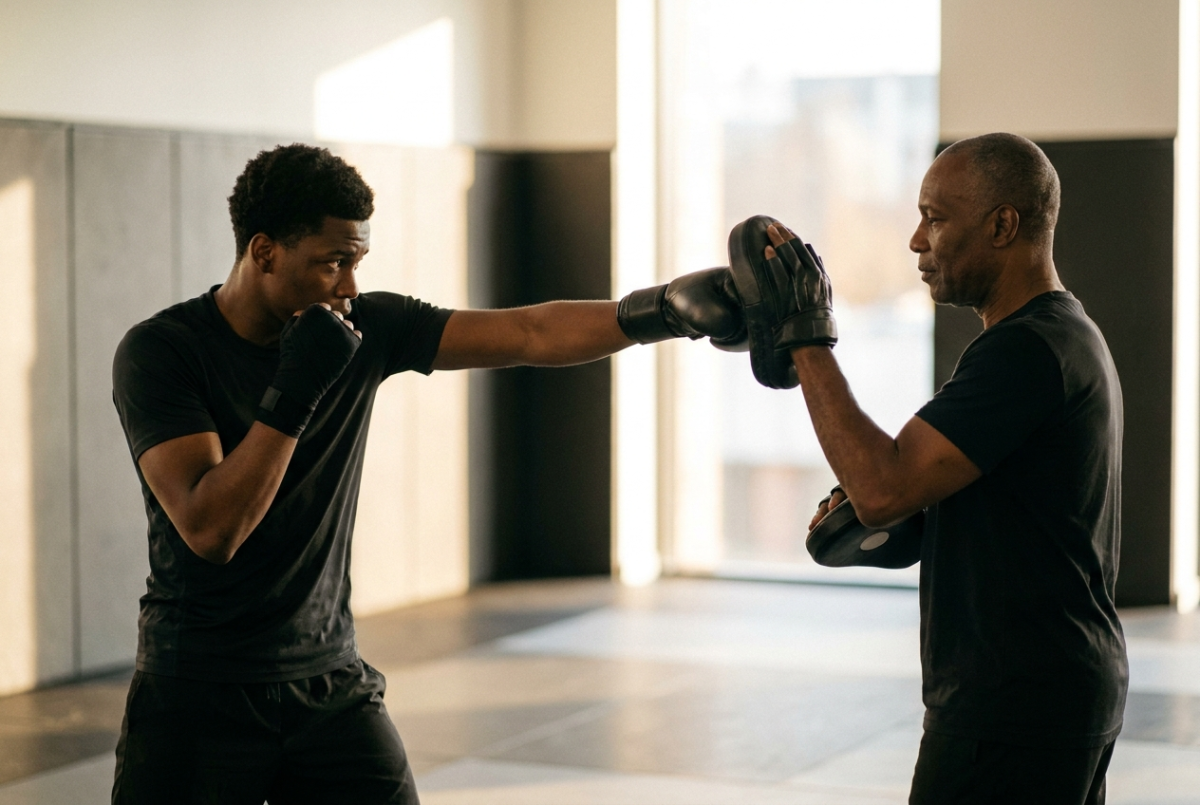
Physical training gives that activation somewhere purposeful to go. Footwork channels restless energy. Repetition gives the mind one clear task. Controlled striking provides intensity without chaos. Breathing between rounds tells the body that effort can end safely.
For many people, this matters because anger isn’t always about rage. It may show up as irritability, snapping at family, shutting down, impatience, constant tension or feeling one inconvenience away from an explosion. Adults carrying work pressure and parents carrying the demands of family life can spend weeks in a state of low-level activation without recognising it.
A consistent boxing practice interrupts that pattern. You arrive carrying the day. You move, sweat, focus and finish with proof that difficult feelings can be carried without being obeyed.
Boxing isn’t a licence to lose control
There’s an important trade-off here. If someone approaches boxing only to rehearse violent thoughts, glorify dominance or hit harder whenever they feel upset, training can reinforce the wrong pattern. Intensity without guidance isn’t emotional regulation.
The quality of coaching matters. A psychologically informed boxing environment sets clear rules: protect your training partner, use appropriate contact, stop when instructed, manage your pace and respect the room. These boundaries aren’t restrictions on progress. They’re the training.
Real composure isn’t passive. It’s the ability to access power without being controlled by it.
This is especially relevant for young people. Children and teenagers need adults who can teach them that strong emotions are normal, while aggression towards others isn’t acceptable. Boxing can help them experience confidence, competence and healthy challenge, but it should never be used as punishment for anger or as a way to “toughen up” a distressed child.
The skills boxing builds beyond the gloves
The benefits aren’t magical, and they don’t appear after one hard session. They develop through repetition. Every class offers small opportunities to practise skills that transfer beyond the gym.
Breathing before reacting
Boxers learn quickly that holding their breath makes everything harder. It drains energy, tightens the body and reduces clear thinking. Exhaling with each strike and recovering between rounds is a practical lesson in down-regulation.
When frustration rises outside training, that same habit can become available: pause, lengthen the exhale, lower the shoulders, then decide what happens next. You may still feel angry. You’re simply less likely to hand the steering wheel to that feeling.
Focus under pressure
Boxing demands attention. You must track stance, distance, guard, timing and instruction. When the session is challenging, there’s little room to replay an argument or build a case against someone in your head.
Over time, this can strengthen the ability to direct attention deliberately. For people with ADHD, anxiety or persistent stress, that experience of being fully engaged in a clear task can be particularly valuable. The training still needs to be adapted to the individual, with clear instructions, predictable structure and appropriate sensory demands.
Discipline over mood
Anger often persuades us that action must happen immediately. Boxing teaches timing. You don’t throw every punch at once. You set your feet, protect yourself, wait for the right opening and stay composed after a mistake.
That’s discipline in a practical form: feeling urgency without becoming reckless. You don’t need to be motivated or in a good mood to practise it. You need to show up and follow the structure.
Confidence without intimidation
People who struggle with anger are sometimes carrying the opposite of confidence. They may feel unheard, powerless, ashamed or constantly on guard. Learning a skill-based sport can change that relationship with the self.
As technique improves, confidence becomes less performative. You don’t need to prove that you’re strong because you’ve evidence of your progress. You can be calm because you know you’re capable.
How to use boxing for anger management well
Start with a clear intention. You aren’t training to become numb, frightening or invincible. You’re training to build capacity: the capacity to feel intensity, control your body and make better decisions.
Choose a class with structured coaching, a beginner-friendly culture and an emphasis on safety. Tell the coach, privately if preferred, that stress or anger management is part of your reason for training. A capable coach can help you pace your sessions, give you clear technical anchors and ensure that sparring, if offered, is introduced only when it’s appropriate.
Don’t measure success only by how exhausted you feel afterwards. Notice whether you recover more quickly after frustration. Notice whether you can take correction without spiralling. Notice whether your family, colleagues or friends experience you as more patient and present. These are meaningful signs of progress.
It also helps to create a simple post-training routine. Drink water, allow your breathing to settle and name what changed during the session. Perhaps you arrived tense and left clearer. Perhaps you noticed that your anger was covering disappointment. That reflection turns exercise into emotional education.
When boxing isn’t enough on its own
Boxing can be a powerful support, but it isn’t a replacement for mental health care when anger feels frightening, leads to threats or violence, damages relationships, or sits alongside trauma, depression, substance use or thoughts of self-harm.
In those situations, professional support is a strength, not a failure. A therapist, doctor or qualified mental health professional can help identify what’s driving the anger and build a wider plan. Boxing may still have a place in that plan, especially when it provides routine, community and a healthy relationship with the body.
The same applies if training leaves you more agitated every time. Scale back the intensity, speak with the coach and consider whether more recovery, more sleep or additional support is needed. Pushing harder isn’t always the disciplined choice.
At Edson Breedy Athletics, training is built around a simple principle: your body and mind learn together. Boxing can give anger a structure, but your real win is what happens when life tests you and you remain in command.
Start where you’re. Keep your guard up, your breathing steady and your choices deliberate. Power isn’t the biggest punch you can throw. It’s the moment you realise you no longer need to throw one.
Train your mind. Build your body.
Your first week is just TTD $50, every discipline, every class, no experience needed. Come find out what training with EBA feels like.