How to Improve Kickboxing Balance Under Pressure
September 18, 2026
Yoga for Nervous System Balance That Builds Calm
September 22, 2026
You don’t need to be punished into becoming stronger. You need a plan you can repeat when work is heavy, sleep was poor, your mind is busy, or confidence is low. This guide to beginner strength conditioning is built around that principle: train with enough challenge to adapt, enough structure to stay consistent, and enough awareness to respect where your body is today.
Strength conditioning isn’t reserved for bodybuilders or athletes preparing for competition. It’s the practice of teaching your body to produce force, control movement, tolerate effort and recover well. For a beginner, that can mean standing from a chair with control, carrying shopping without discomfort, holding a stable plank, or learning to throw a clean punch without losing balance.
At Edson Breedy Athletics, we treat physical training as more than exercise. Repeated, well-coached effort can build discipline, confidence and a steadier response to stress. The aim isn’t to prove yourself in one hard session. The aim is to become someone who returns to the work.
What beginner strength conditioning should build
A good programme develops more than larger muscles. It teaches the major patterns your body uses every day: squatting, hinging at the hips, pushing, pulling, carrying and bracing through the trunk. These patterns create a foundation for martial arts, sport, yoga, work and family life.
Conditioning adds the ability to keep performing those movements without your technique falling apart. That doesn’t mean gasping through random circuits until you feel sick. It means gradually improving your work capacity while preserving posture, breathing and control.
For beginners, the biggest gains often come from coordination and confidence. Your nervous system learns the movement, your joints become accustomed to load, and the exercises begin to feel less threatening. This is why starting with manageable resistance isn’t “too easy”. It’s intelligent preparation.
A guide to beginner strength conditioning: start with movement quality
Before adding weight, earn consistency with your body. Choose variations that allow you to move through a comfortable range with control. If a full press-up causes your hips to sag or shoulders to pinch, begin with an incline press-up against a bench or wall. If a deep squat feels unstable, use a box or chair as a target.
Use a simple standard: the final repetition should look close to the first. A small slowing down is normal. Sharp pain, dizziness, numbness, joint catching or a complete loss of position isn’t a sign to push harder. Stop, adjust the exercise and seek appropriate professional advice if symptoms continue.
Breathing is part of technique. In most beginner movements, breathe in as you prepare and breathe out through the hardest part. Don’t hold your breath for long periods just to force a repetition. A controlled exhale can help the body manage effort without escalating tension unnecessarily.
This matters especially for trainees who live with anxiety, ADHD, autism or depression. A loud, unpredictable room or an overly complex session can make training feel like another demand the nervous system must survive. Clear demonstrations, repeatable routines and permission to scale an exercise aren’t lowered standards. They’re how standards become achievable.
Build your first two-day routine
Two full-body strength sessions each week are enough to create meaningful progress. Leave at least a day between them when possible. You can walk, attend yoga, practise martial arts skills or do light mobility work on other days, but don’t confuse constant exhaustion with commitment.
Begin each session with five to eight minutes of easy movement. Walk, cycle gently, skip lightly if your joints tolerate it, or practise relaxed shadowboxing. Follow this with a few rehearsals of the exercises you’ll perform. The warm-up should leave you more prepared, not tired.
For the main work, select one movement from each category:
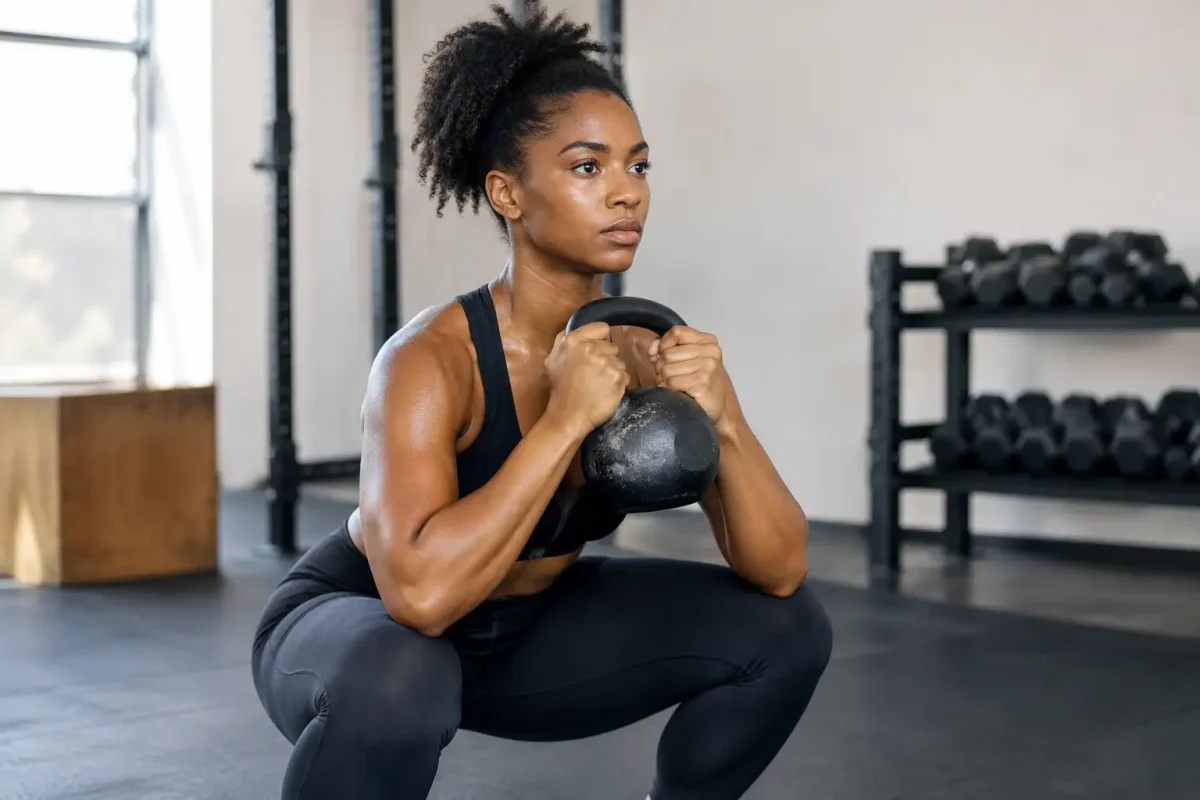
- Squat: chair squat, goblet squat or supported split squat.
- Hinge: hip bridge, light Romanian deadlift or kettlebell deadlift from an elevated position.
- Push: wall press-up, incline press-up, dumbbell floor press or overhead press.
- Pull: resistance-band row, cable row or supported dumbbell row.
- Carry or brace: farmer carry, suitcase carry, dead bug or plank.
Perform two to three sets of six to 12 repetitions for the squat, hinge, push and pull. For carries, use two to three controlled walks of 20 to 40 seconds. For planks or dead bugs, work in short sets where you can breathe normally and keep your ribs and pelvis from flaring apart.
Rest for roughly 60 to 120 seconds between sets. Rest longer if your breathing is still frantic or your form is slipping. The correct rest period depends on the exercise, your sleep, your fitness level and the day you’re having. Discipline is following the plan, not rushing through it.
Choose effort, not ego
A useful beginner target is to finish most sets feeling that you could complete two or three more good repetitions. Coaches often call this leaving repetitions in reserve. It gives your body enough stimulus to change while reducing the chance that fatigue turns every session into a technical mess.
The weight itself is only one form of progression. First, make the movement smoother. Then add a repetition. Then add another set, a little resistance, a slightly longer carry, or a more demanding variation. Change one variable at a time so you know what your body is responding to.
For example, if you can complete three sets of 10 chair squats with a stable torso and no knee pain for two sessions, you might hold a light dumbbell at your chest next time. You don’t need to leap from beginner to advanced because a video online tells you that suffering is the price of progress.
Keep a short training record. Write down the exercise, resistance, sets, repetitions and one note about how it felt. “Felt strong”, “right knee stiff”, “poor sleep but completed session” and “ready to add one rep” are all useful. Patterns become visible when you stop relying on memory.
Recovery is part of the programme
Strength improves between sessions, when your body has the resources to repair and adapt. Aim for regular sleep, enough water, meals that include protein and carbohydrates, and some daily movement outside formal training. You don’t need a perfect lifestyle before you start. You need a few repeatable decisions.
Training can help regulate stress, but hard exercise is still a stressor. On a high-pressure week, reduce one set, choose easier variations or take a longer rest. This isn’t quitting. It’s autoregulation: matching the session to your current capacity so that you can train again.
Be particularly cautious if you’re returning after injury, have a health condition, take medication that affects exercise tolerance, or are pregnant or recently postpartum. A qualified coach can adapt movements, but medical guidance may also be needed. Good training works with the body in front of you, not an imaginary version of you.
Let strength support the rest of your life
The value of strength conditioning shows up outside the training floor. You may notice that stairs feel easier, your stance is stronger in boxing or Taekwondo, and your posture holds up longer at work. You may also notice a quieter kind of confidence: the evidence that you can meet discomfort, stay organised and complete what you planned.
For parents, this process matters for children and teens too, although their training should be age-appropriate, coached and centred on movement skill rather than adult-style loading. Young people benefit from learning balance, coordination, safe landing, body awareness and the connection between effort and progress. They don’t need shame as motivation.
There will be sessions when you feel powerful and sessions when every repetition feels ordinary. Both count. Stop negotiating with yourself over whether a workout must be perfect to be worthwhile. Show up, practise the basics with intent, and let small acts of discipline become the strength you can rely on.
Train your mind. Build your body.
Your first week is just TTD $50, every discipline, every class, no experience needed. Come find out what training with EBA feels like.