Is Jiu Jitsu Safe for Beginners? What to Expect
October 10, 2026
How to Start Strength Training Safely as a Beginner
October 14, 2026
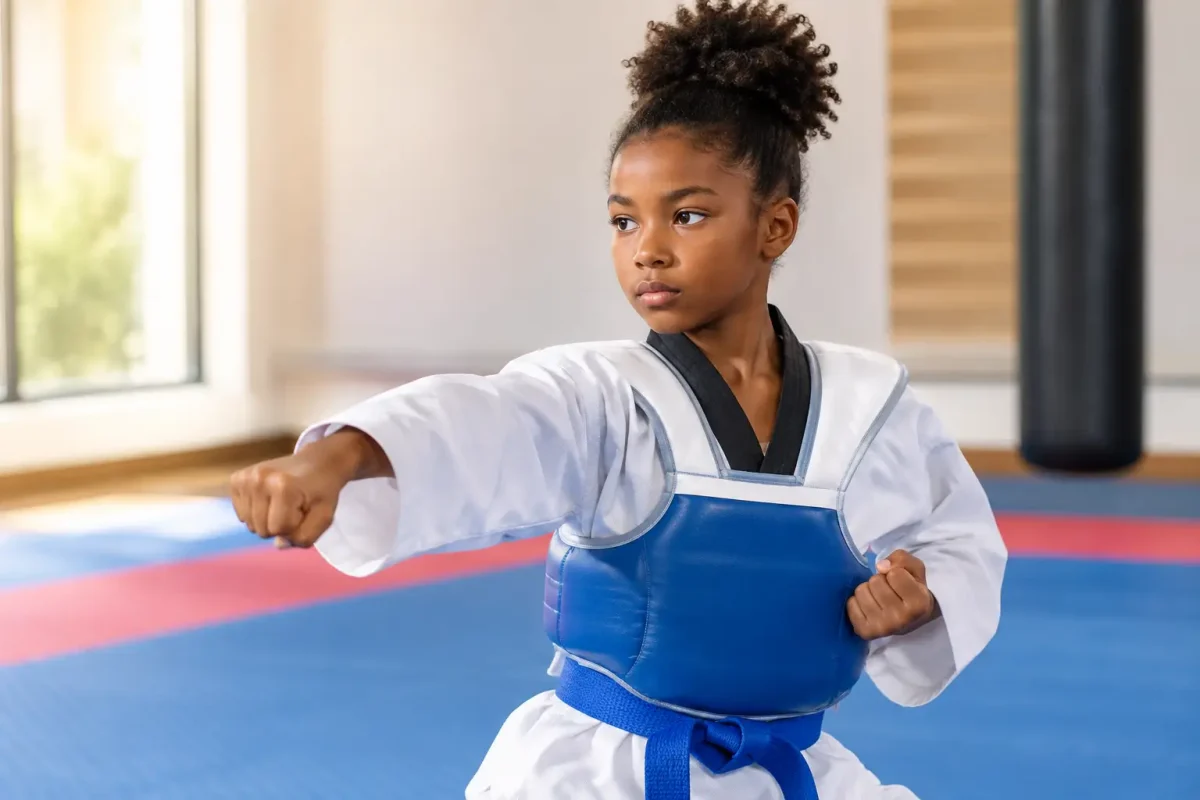
A child who once avoided eye contact, struggled to wait their turn, or gave up after one missed kick can become the same child who stands tall, resets, and tries again. That’s the kind of kids taekwondo progress parents should learn to recognise. It isn’t always loud. It doesn’t arrive only when a new belt is tied around the waist.
A belt matters because it represents standards met. But the deeper work happens between gradings: arriving on time, listening when excited, managing frustration, practising a difficult pattern, and learning that effort has a place even on days when motivation is low.
At Edson Breedy Athletics, progress is built through structured instruction, clear expectations, and coaching that understands the connection between the body, brain, and behaviour. Children don’t need empty praise. They need a safe environment where effort is noticed, standards are consistent, and challenge is matched with support.
Kids taekwondo progress starts before the first belt
Parents often ask, “How quickly will my child progress?” The honest answer is that it depends. Physical coordination, previous activity, attendance, sleep, confidence, learning style, and emotional regulation all affect the pace. A child may learn combinations quickly but need more time to control impulsive behaviour. Another may be quiet at first yet show remarkable patience and technical precision.
Neither child is behind. They’re developing different parts of the same foundation.
Taekwondo gives children a visible framework for development. They bow before entering the training space. They follow a sequence. They respond to instruction. They work with partners while respecting boundaries. Repeated often enough, these actions become more than class rules. They become rehearsals for self-control.
That repetition matters to the nervous system. Predictable routines reduce uncertainty. Clear commands give children a next step when their thoughts feel scattered. Physical exertion offers an appropriate outlet for energy, tension, and stress. Then recovery, breathing, and stillness teach the equally valuable skill of returning to calm.
This is why a well-run class isn’t simply a place for children to burn energy. It’s a place to practise directing it.
What meaningful progress looks like at home and school
A stronger kick is easy to spot. More meaningful changes can be quieter, and they may appear outside the dojang before they appear in class.
A child may begin preparing their uniform without a reminder. They may handle a correction without tears or anger. They may speak more clearly when introduced to adults, complete a task before asking for a screen, or recover faster after losing a game. These aren’t guaranteed outcomes, and martial arts should never be presented as a cure for every challenge. They’re, however, common signs that a child is learning discipline as a practical skill.
Look for trends rather than perfection. Every child will still have difficult days. They’ll be tired, distracted, frustrated, or resistant at times. Progress means the recovery is becoming quicker and the tools are becoming more familiar.
Focus becomes trainable
Children are often told to “pay attention” without being shown how. In Taekwondo, focus has a physical job. Watch the coach. Set the stance. Remember the next movement. Hear the count. Keep safe distance from a partner.
For children with ADHD, this can be especially valuable when coaching is structured and responsive. Movement isn’t treated as misbehaviour by default. Instead, it’s shaped through boundaries, purposeful drills, short instructions, and consistent redirection. The aim isn’t to make a child smaller or quieter than they’re. The aim is to help them direct their attention and energy with increasing control.
Confidence becomes evidence-based
Real confidence isn’t built by telling a child they’re amazing regardless of effort. It’s built when they experience proof: “I couldn’t do that last month. I practised. Now I can.”
A new technique, a completed pattern, a successful pad round, or the courage to stand in front of the class all create evidence. Over time, the child begins to trust their ability to learn difficult things. That belief transfers. It can support classroom participation, social confidence, and willingness to try again after a setback.
Emotional control becomes a habit
Taekwondo is demanding. Children will make mistakes. They’ll miss blocks, lose balance, forget sequences, and sometimes feel embarrassed. That isn’t a failure of the programme. It’s part of the lesson.
A skilled coach doesn’t shame the mistake or rush to rescue the child from every uncomfortable feeling. They help the child pause, listen, correct, and re-enter the task. This process builds resilience without confusing toughness with emotional suppression. A resilient child isn’t one who never feels upset. It’s one who learns what to do next when upset arrives.
Belts are milestones, not the whole measure
Belt progression gives children a clear goal and makes effort visible. It can be highly motivating, especially for children who benefit from concrete markers of achievement. Yet belts can also become unhelpful when adults turn them into a race.
Comparing one child’s belt to another’s ignores what each child is working through. A child who takes longer to grade may be building stronger fundamentals. Another may need additional time to develop confidence in front of others. Fast promotion without real readiness can feel rewarding briefly, but it weakens the meaning of the achievement.
The better question isn’t, “Why is my child not on the next belt yet?” Ask, “What are they learning to do consistently?” Consistency is the standard that holds when excitement fades.
Parents can support the process by respecting the academy’s grading criteria, celebrating effort as well as outcomes, and avoiding turning training into a bargaining tool. “If you get the next belt, then you can have a reward” can shift attention away from personal responsibility. A better conversation is: “What did you practise today when it became difficult?”
The role parents play in sustained progress
Children borrow their standards from the adults around them. If attendance is optional whenever the day feels inconvenient, they learn that discomfort is a reason to stop. If training is treated as a commitment, they learn that commitments matter.
This doesn’t mean forcing a child through illness, injury, genuine distress, or an unsuitable class environment. Good discipline isn’t blind pressure. It requires judgement. There will be weeks when school demands increase, family schedules change, or a child needs a conversation rather than another instruction.
Still, avoid negotiating with every momentary complaint. A child may say they don’t want to train because the class is challenging, because they had a hard day, or because they would rather be on a device. Those feelings are real. They don’t always need to make the decision.
Be calm and direct: “You don’t have to feel like it. You do have to show up.” Once class begins, many children reconnect with the routine, movement, and sense of belonging they needed.
At home, keep support simple. Ask one specific question after class, such as what felt difficult or what they improved. Make sure they’ve water, rest, and a consistent routine around training days. Praise courage, attention, and respectful behaviour, not only medals or powerful kicks.
When progress seems slow
Slow progress deserves curiosity, not criticism. A child may be overwhelmed by a busy environment, processing instructions differently, worried about getting something wrong, or simply adjusting to a new routine. For autistic children, anxious children, and children with sensory sensitivities, predictability and patient coaching can make a major difference.
Speak with the coach early. Share what helps your child regulate, communicate, and feel safe. The goal isn’t to remove every challenge. It’s to present challenge in a way the child can meet and gradually expand.
There’s also a physical side. Poor sleep, hunger, dehydration, growth spurts, and school stress can all change performance. One difficult session is information, not a verdict. Watch patterns across several weeks before assuming a child lacks ability or commitment.
The strongest young martial artists are rarely the children who never struggle. They’re the children who learn to stay connected to the process while they struggle.
A child won’t remember every combination they learned. They’ll remember the feeling of doing something hard, being guided without judgement, and discovering they could continue. Give them enough time to earn that feeling. Discipline grows there.
Train your mind. Build your body.
Your first week is just TTD $50, every discipline, every class, no experience needed. Come find out what training with EBA feels like.