7 Best After School Activities for Focus That Build Discipline
September 30, 2026
Is Sparring Compulsory in Martial Arts Classes?
October 4, 2026

A hard round on the pads can do more than raise your heart rate. It can interrupt a day of racing thoughts, give a restless child a clear task, or remind an exhausted adult that they can still keep a promise to themselves. That’s the real value of brain health exercise: training the body in a way that also develops attention, emotional control and confidence.
The goal isn’t to exercise your way out of every mental health challenge. Anxiety, depression, ADHD and autism deserve informed support, and some people will need clinical care alongside training. But movement, skill practice and dependable routine can be powerful parts of a wider plan. Done well, training gives the brain repeated evidence that effort can become control.
What brain health exercise actually means
Brain health exercise isn’t a special gadget, a complicated puzzle app or an hour spent forcing yourself through a workout you hate. It’s physical activity that challenges the systems behind how you think, feel and respond: attention, coordination, memory, stress regulation, decision-making and self-belief.
A steady walk can help. Strength training can help. Yoga can help. But activities that combine movement with learning and clear feedback often bring an extra layer of benefit. In martial arts, you must notice posture, listen for instruction, remember a sequence, regulate your breathing and respond without losing control. Your body is moving, but your mind is practising order under pressure.
This matters because the brain responds to repetition. Every time you arrive, warm up, practise a technique and finish what you started, you reinforce a useful pattern: discomfort isn’t danger, and challenge doesn’t have to become chaos.
Why skill-based training can calm a busy mind
Many people try to reduce stress by doing less. Rest has its place, but an unstructured mind often fills empty space with worry. Purposeful training provides a different route. It gives your attention somewhere specific to go.
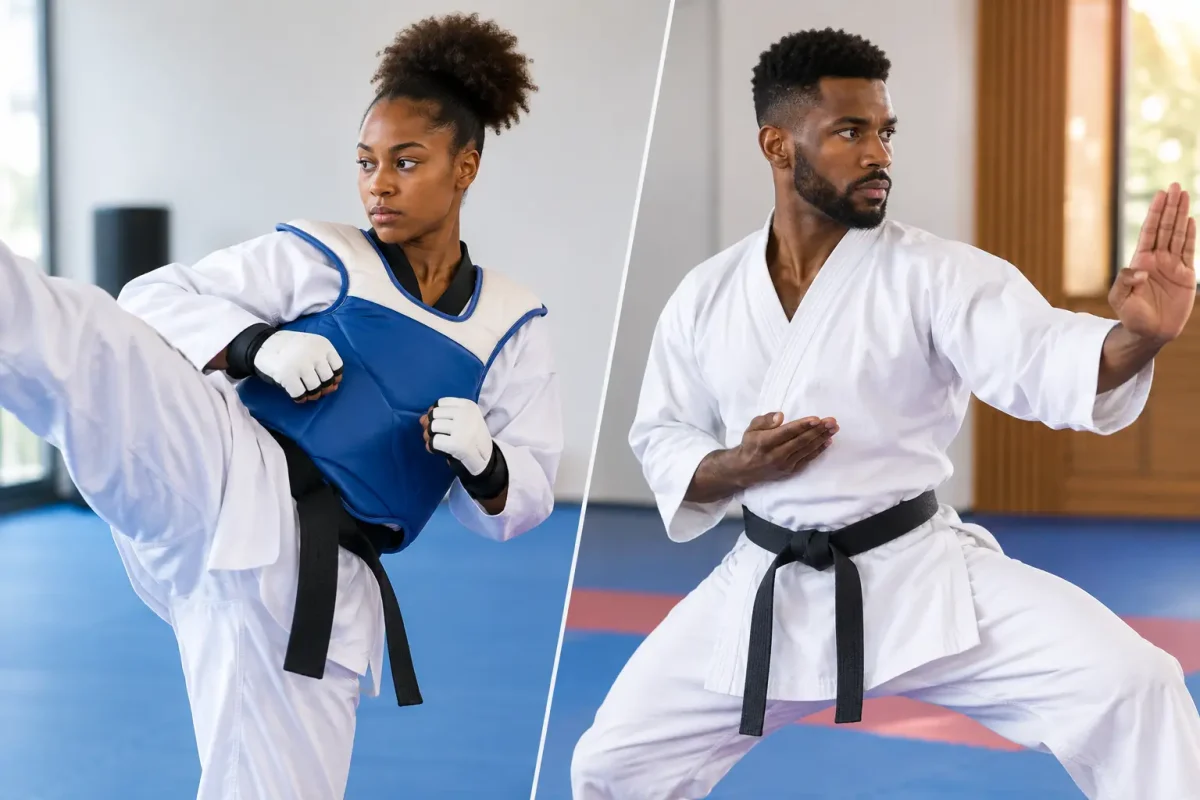
On a boxing combination, there’s little room to replay an argument from work. In a Taekwondo drill, you must think about balance, distance and timing. During jiu-jitsu, panic is rarely useful; breathing, position and patience are. These aren’t just sporting lessons. They’re rehearsals for life outside the training floor.
The trade-off is that intensity must be appropriate. A punishing session may leave one person feeling clear and capable, while another feels overstimulated or defeated. More isn’t always better. The right session is challenging enough to demand focus, but structured enough that you can finish feeling more settled than when you arrived.
Discipline gives the nervous system something reliable
Motivation is unreliable. It changes with sleep, weather, workload and mood. Discipline is the decision to follow a helpful structure even when motivation is absent.
That doesn’t mean ignoring your body or forcing maximum effort every day. It means having a standard: attend the class, complete the warm-up, communicate when you need an adjustment, and return next time. Consistency reduces the daily debate. Stop negotiating with yourself.
For someone living with anxiety, a predictable session can become a grounding point in the week. For a child with ADHD, clear rules and short, active drills can create an environment where energy is directed rather than criticised. For a teenager who has lost confidence, gradual technical progress can offer proof that identity isn’t fixed.
Structure isn’t restrictive when it’s well coached. It’s supportive. Knowing what happens next frees up mental energy for the work itself.
The most useful forms of exercise for brain health
There’s no single best discipline for everyone. The strongest choice is usually the one you can attend consistently, enjoy enough to sustain, and progress within safely. A balanced programme often combines several types of training.
Martial arts develop focus, coordination, self-control and respect for boundaries. The aim isn’t uncontrolled aggression. Good coaching teaches people to manage force, follow rules and remain composed when challenged.
Strength and conditioning build physical capability, but they also build self-efficacy. Adding a repetition, improving your squat position or completing a difficult circuit teaches a simple lesson: practice changes capacity.
Boxing and kickboxing can provide a direct outlet for tension. The rhythm of combinations, footwork and pad work demands attention. However, technique and pacing matter. Training should leave you empowered, not injured or depleted.
Yoga and mobility work strengthen the quieter side of resilience. Slower movement, balance and breath awareness can help people notice tension before it takes over. This is particularly valuable for those who spend most of the day in a heightened state of alert.
The best programmes don’t treat these methods as competitors. They use them as tools. Some days you need to hit pads. Some days you need to lift. Some days you need to slow down long enough to notice your breathing.
Brain health exercise for children and teenagers
Children don’t need a lecture on neuroscience before class. They need safety, consistency, movement and adults who mean what they say. A well-run martial arts or fitness class can teach them to wait for a cue, work with a partner, tolerate correction and recover after making a mistake.
Those skills carry into school, home and friendships. A child who learns to reset after losing balance during a drill is learning something bigger than a kick. They’re learning that errors are information, not a verdict.
For neurodivergent children, one approach doesn’t fit everyone. Some may benefit from visual demonstrations, clear routines and reduced sensory overload. Others may need movement breaks, more repetition or instructions delivered one step at a time. Inclusion isn’t lowering standards. It’s creating a pathway to reach them.
Parents should look for coaching that’s firm without humiliation. Discipline works best when a child understands the expectation, receives consistent feedback and feels secure enough to try again.
A practical weekly framework
You don’t need to train every day to support your brain health. You need a routine that fits your life and survives busy weeks. For many beginners, three purposeful sessions is a strong starting point: one skill-based class, one strength or conditioning session, and one lower-intensity session such as yoga, mobility work or a brisk walk.
If you’re already active, add challenge gradually rather than chasing exhaustion. Increase complexity before simply increasing volume. Learn a new combination, improve your form, practise controlled sparring or work on a movement that requires balance. The brain benefits when the body has something meaningful to learn.
Protect recovery with the same seriousness you bring to training. Sleep, hydration, regular meals and rest days affect concentration and mood. Training hard while sleeping poorly and living on stimulants isn’t discipline. It’s a short-term strategy with a long-term cost.
Measure progress beyond the mirror
Aesthetic goals are valid, but they’re too narrow to carry most people through difficult weeks. Track signs of progress that matter in daily life. Are you less reactive after a stressful meeting? Can you focus through a full class? Do you recover faster after frustration? Are you more willing to speak up, try again or hold a boundary?
Physical training should make life larger, not smaller. If your programme is feeding injury, dread, obsessive thinking or constant fatigue, the answer may be to adjust the load, the environment or the coaching style. Resilience isn’t pretending that every plan works. It’s responding intelligently when one doesn’t.
At Edson Breedy Athletics, training is built around that principle: the body isn’t separate from the mind, and progress isn’t limited to what happens in front of a mirror. Whether you’re a beginner, a parent seeking structure for your child or an experienced trainee who needs renewed purpose, start with the next repeatable action. Attend. Learn. Breathe. Return. Over time, that practice becomes more than exercise. It becomes a steadier way to meet your life.
Train your mind. Build your body.
Your first week is just TTD $50, every discipline, every class, no experience needed. Come find out what training with EBA feels like.